
Useful Guides
A Smarter Way to Handle Shopify Products for Variants, Inventory & SEO
How you structure products in Shopify has a bigger impact on search visibility, stock control and long-term scalability than almost any design choice. This guide sets out a practical way to think about Shopify product architecture, with a focus on variants, inventory management and SEO.
One of the hardest parts of building a good Shopify store is deciding how products should actually be structured.
Not visually. Structurally.
How many products you create, how variants are handled, how inventory is tracked, and how all of that shows up in search engines has a bigger impact on performance than most theme decisions.
Get it wrong and you end up fighting the platform. Get it right and everything else becomes easier.
What product architecture means in Shopify
In Shopify, product architecture is the relationship between products, variants, inventory, URLs and collections.
Shopify is very good at managing stock and fulfilment. It is far less opinionated about how products should be structured for search, merchandising and discovery. That flexibility is one of its strengths, but it’s also where many stores run into trouble.
The core tension in Shopify product setup
Most founders encounter the same underlying problem, even if they don’t articulate it this way.
Keeping everything under a single product with multiple variants makes inventory and reporting simple. But from an SEO and content perspective, everything collapses into one page. Options that deserve their own story end up hidden behind a selector.
Splitting those options into separate products improves visibility, copy depth and merchandising. But inventory becomes harder to manage, reporting fragments and admin overhead increases.
Neither approach is wrong. Each simply optimises for one side of the problem.
A more flexible way to think about Shopify products
The shift is to stop treating inventory and presentation as the same concern.
Inventory benefits from consolidation. SEO and merchandising benefit from specificity. Shopify supports this separation better than most people realise, if you’re willing to think beyond default setups.
Separating variants without fragmenting inventory
Shopify’s product model allows a single variant to act as the underlying stock source, while being presented to customers in more than one way.
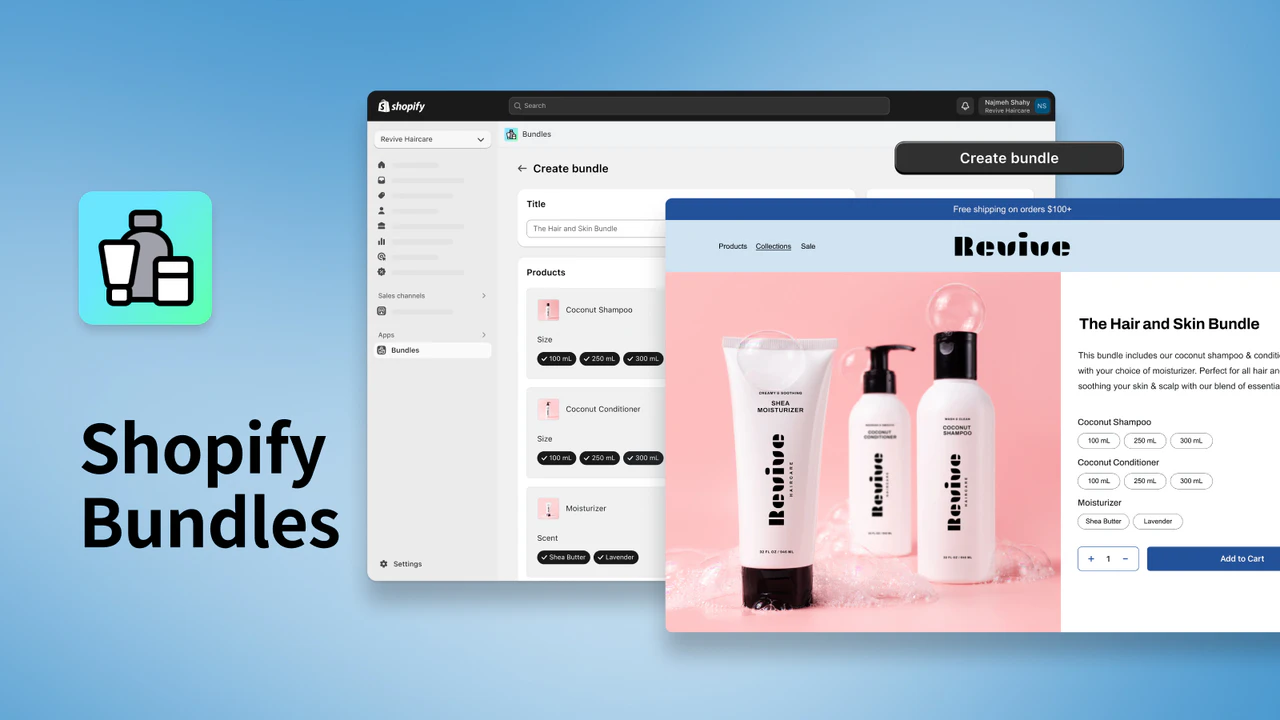
This is where the Shopify Bundles app becomes genuinely useful.
Used structurally, it allows a single variant to exist as its own top-level product, complete with its own URL, imagery and copy, while still drawing from the same inventory pool as the original product.
Sales from either surface reduce the same stock. Reporting remains coherent. Inventory stays accurate.
This isn’t a workaround or a hack. It’s Shopify doing exactly what it’s designed to do.
Why this improves SEO in practice
Search engines reward clarity and relevance.
A page focused on a specific flavour, finish or use case will almost always outperform a generic parent product with a dropdown, particularly when search intent is narrow.
Structuring products this way allows you to create genuinely useful pages that match how people search, without duplicating stock or overcomplicating operations. SEO improves not because of a trick, but because the structure finally makes sense.
When this approach works best
This approach is most effective when variants carry their own intent. When customers come back for the same option repeatedly. When story, ingredients or use-case matter.
Food, drink, supplements, skincare, fragrance and lifestyle brands tend to benefit most. If variants are truly interchangeable, simpler structures are often the better choice.
The discipline that makes this work
Good architecture still requires restraint.
Not every variant needs its own page. Not every product deserves to exist twice. Copy needs to be written properly, not duplicated. Choice should feel deliberate, not exhaustive.
The goal is clarity, not volume.
A long-term decision, not a design detail
Most Shopify rebuilds focus on visuals first. The strongest ones start with structure.
Once product architecture is right, collections become easier to manage, navigation becomes clearer, SEO compounds naturally and new products slot into place without friction.
This is the kind of decision that quietly pays off over years, not weeks.
Where this sits in a wider Shopify strategy
Product architecture sits at the centre of a good Shopify build.
It affects collection UX, navigation, filtering, content strategy, performance and scalability. It’s also one of the hardest things to change once a store is live.
Getting it right early reduces friction everywhere else.
Closing
If you’re planning a Shopify rebuild, migration or range expansion, this is the level where careful thinking makes everything else easier.
I work with founders to design Shopify stores that are structurally sound, commercially practical and built to scale.

You may also be interested in…
How to optimise your Shopify store for increased conversion rates

ARTICLES OF INTEREST


Guide: How to improve your shopify Conversion Rates
5 Quick Tips to improve your chances of making a sale on your e-commerce store

Published
Last Updated